

A brief introduction
In today’s newsletter we have a wonderful guest, Bastiaan Woudt, who describes a longer term project he’s titled Henro. You may recall Bastiaan from another occasion as guest writer for a newsletter back in June, The Print As The Work. If you are interested in seeing the Project Henro as it is meant to be seen there is a list at the end of Galleries where the original prints can be seen at the end of this newsletter.
If your not lucky enough to be located close enough to the scheduled exhibitions to experience them in person, Bastiaan’s publishing house has a number of beautifully rendered editions of the Henro project in book form. Some of these very special editions also contain original prints. Take a look and for a limited time he’s been gracious enough to provide our readers with a discount using the code PAC10.
Enjoy…
A fascinating walk-through of the project Henro written by its creator Bastiaan Woudt
A photograph made in Japan should end on Japanese paper. That was the easiest decision in this project, and it still took two years to act on. Last time I wrote that the paper, the technique and the studio behind them deserved their own piece. This is it.
In March 2024 my brother and I went to Shikoku to cycle the Henro, one of the oldest pilgrimage routes in the world, a circle of 88 Buddhist temples strung across more than 1,200 kilometres of mountains, forests and coastal roads. The route crosses four prefectures, each standing for a stage of the pilgrimage, from awakening to nirvana. People have been walking it for over a thousand years, and we cycled it, which sounds like a shortcut and is not. Cycling put us in a rhythm between speed and stillness, fast enough to cover the distance, slow enough to stay exposed to the weather, the fatigue, the silence and the people who stopped us along the way. There was no plan and no shot list. I did not go to Japan to make photographs. I went to move through a landscape that asks nothing of you except attention, and I took a camera because I always do.
What came back with me was not a record of the trip but a set of fragments. The ride was over in a matter of weeks. Working out what the work actually was took two years, and that time went into two things. First the selection, sitting with the images, laying them next to each other, deciding which ones belonged together and letting the rest go. Then the paper. Before Henro there was Echo From Beyond. That work is made with AI, which puts it about as far from a pilgrimage in Japan as anything I have made, and it exists as a single one-of- one print. Luc Brefeld printed it with piezography on Awagami Bizan White Medium Handmade.
That name is misleading if you have never held the sheet. Medium describes the surface, not the substance, and the 200 grams tells you nothing you would want to know. A Western paper at that weight is a stiff card. This is not that. It has bulk without hardness, it gives a little when you pick it up, and the four deckle edges are not trimmed but the boundary where the sheet simply ended when it was made. Hold it against a low light and the surface is never flat. You can see the fibres lying in it.
Piezography uses carbon pigment inks only and every print is made by hand, which means the paper is never just the surface the ink lands on. It is half the result. That print was the first time I saw what these two things do to each other, an image made with the newest tools I have, sitting on one of the oldest surfaces available for one. I did not know it then, but it was the test case for Henro before Henro existed.
So when the Henro images finally needed paper, we tested anyway. Many papers, several rounds, sheets laid beside each other until the differences stopped being theoretical. And we came back to the Bizan. Everything we tried was measured against the thing I already had, and nothing beat it. I wrote last time that I barely test anymore, and that when I do it is because I am pushing into something new. This was that, and the pushing sent me back to where I started.


Printed full bleed at 21 by 32 centimetres, with the edges left intact, the print stops behaving like a print. It becomes an object you hold.
The large works were the open question, because that paper does not exist at the sizes I needed. So we kept looking for something that would sit beside it without arguing with it, and ended up with Haini Tosa Kozo, 40 grams, made from kozo fibres, mulberry bark, in the Tosa region of what is now Kochi prefecture. Haini means ash boiled. The fibres are cooked in lye made from wood ash, the way it has been done there for centuries. Kochi is one of the four prefectures we cycled through.
What the paper does to the image starts before the paper. I shoot digitally, and the coarse grain and heavy texture in these files are put there by me. That is worth being clear about, because it is not borrowed from an older process and it is not nostalgia.


It is subtraction. I work in black and white, and I push grain and texture on top of that, and both do the same thing. They take away description. The sharpness that would tell you exactly which tree this is, the fine detail that would let you find the spot on a map, the clean surface that invites you to identify things instead of looking at them. All of that goes, and what is left moves away from the place and toward what I actually came back with. I did not return from Shikoku with a record of a route. I came back with fragments that behave the way memory behaves: certain about one shape, vague about everything around it. Grain is how I get an image to do that. It is not there to obscure the subject. It clears away what was competing with it.
Then the paper adds a structure of its own, almost like linen, with a coarse fibre running through everything, refusing to lie flat and neutral under the picture. Between the two, the image drifts out of photography altogether and begins to read as an etching, or something painted, or a charcoal drawing. The carbon ink finishes it. These prints are matte in a way I had not seen before, almost unreal, and of everything I have shown in the studio nothing has drawn a response like them.
The book was a different challenge. HENRO is published by 1605 Collective, designed with Janneke Schrey, in an edition of 750, and printing a run that size on washi was never realistic. Rather than chase the same paper I went looking for a connection in structure, and the inner paper became Munken Lynx Rough, 150 grams, rough under the hand and warm in colour, close enough to the paper on the wall that the two feel related without pretending to be the same. Both carry the images well, and I mean that. The book is not a compromise. On the Japanese paper, printed with carbon ink, the work is simply at its best, and no press will ever reach that. It is a different craft with a different ceiling.


They are not doing the same job, and I would not want them to. The book is a sequence. You hold it and turn, and the images arrive in the order I chose, which is the closest I can get to the rhythm of the ride. A print does the opposite. It stops you in front of one image, at a size that will not fit in your hands, on a surface you can read from across a room. I do not think of the book as a lesser version of the print. It is a different reading of the same images, and it is the only one of the two that can be in 750 places at once.
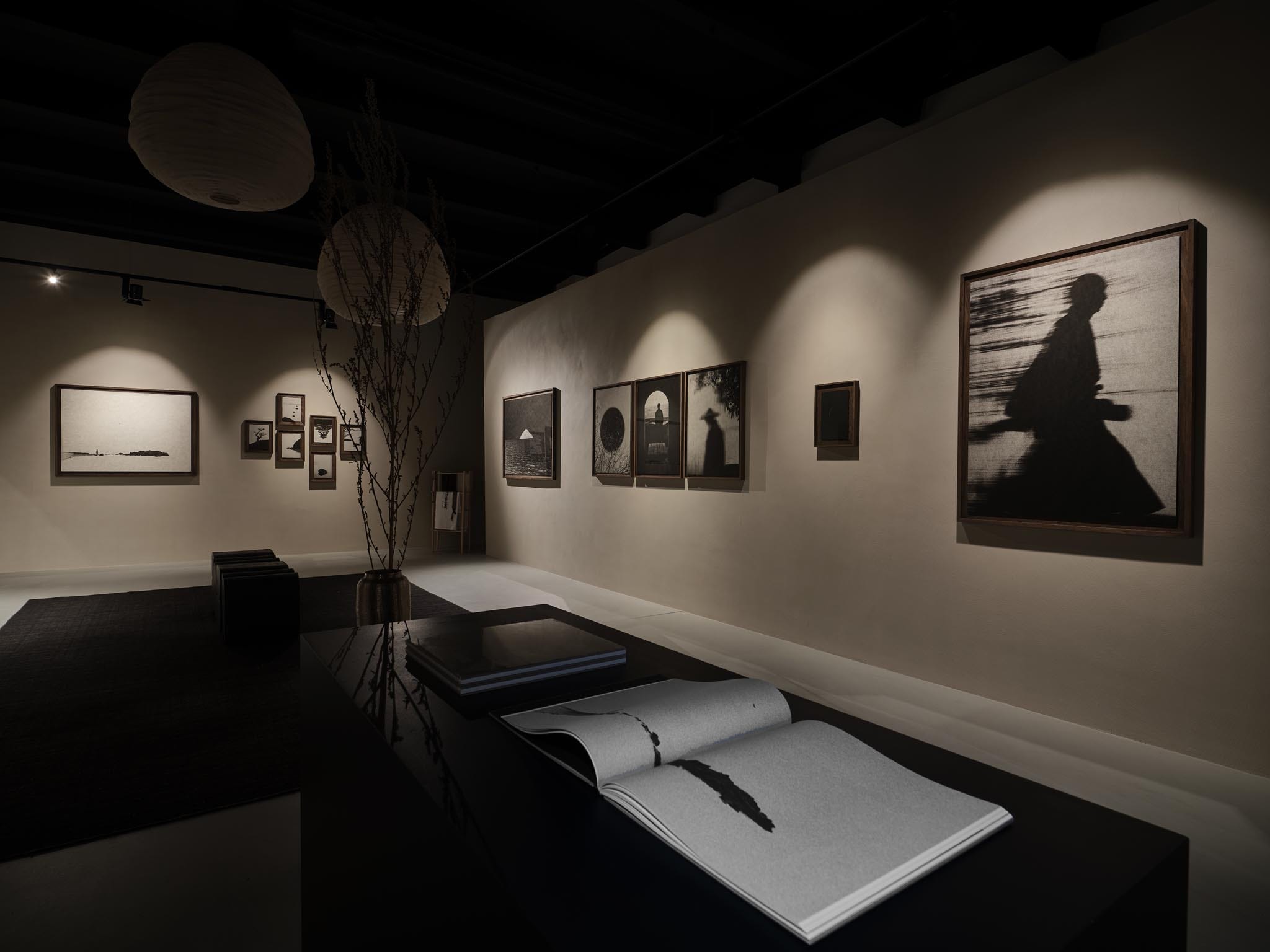
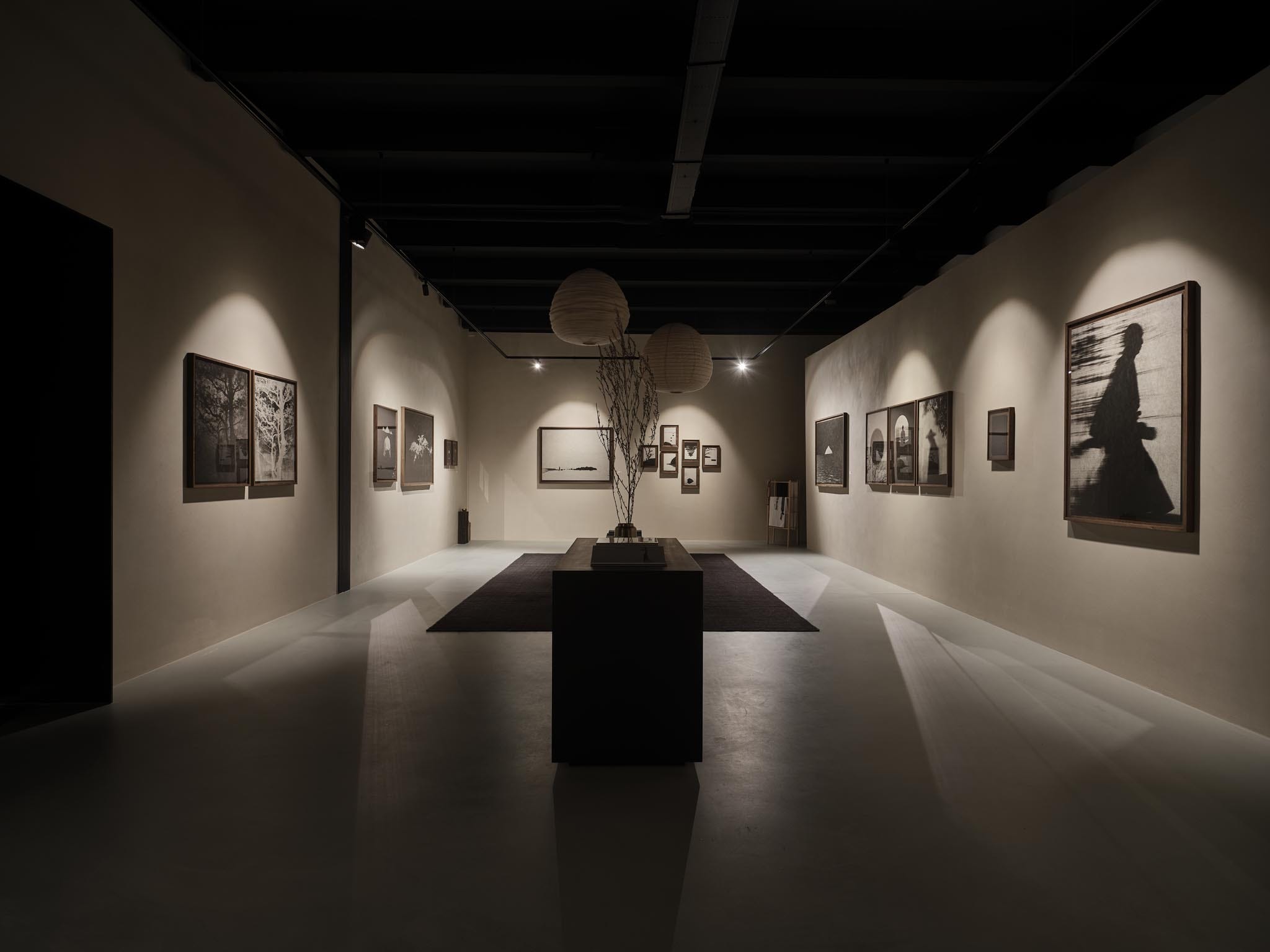
The work is on view at my studio in Alkmaar until 20 September, and a room makes the argument better than an essay can. These are framed in smoked walnut instead of the black frames I normally use, the large works set straight into the frame behind a shadow gap with no mat, the small ones floating in a shadow box against dark wood. Matte paper gives almost nothing back to the light, so the print never competes with the window or the lamp above it. People end up standing closer than they meant to.
From there the work travels on. Part of the series goes to Milan for a solo exhibition at MC2 Gallery opening on 10 September, and the work is now also at Jackson Fine Art in Atlanta. The paper under the largest prints comes from Kochi, and we cycled through Kochi without knowing what it would later give the work. It took two years to arrive there, and I do not think it could have gone any faster.
WHERE TO SEE THE WORK HENRO
Studio Woudt, Alkmaar, until 20 September 2026
THE SHAPE OF ABSENCE solo exhibition, MC2 Gallery, Via Maroncelli 7, Milan, opening 10 September 2026
Jackson Fine Art, Atlanta
I have this book and been to the gallery and can say with full confidence that it is a must-see IRL.
Wonderful example of the intersection of fine writing and fine photography. I could feel the paper as you wrote about it, and I can see the work with much of its nuance in my mind's eye.