
On the day I’m writing this I received an email from Breathing Color, a paper and accessory manufacturer, with a link to their tips for properly handling prints.
Breathing Color is a respectable source for printing information and I’ve found them to be a reliable source of quality papers and accessory products (Disclosure: my studio is sponsored by Moab Fine Art Papers and Awagami). I found their article and the tips it offers to be a good reference for anyone who prints their images. Their customer service is top-notch.
Having said that, I’d like to comment on a few items and add my own tips regarding what I call print hygiene.
There is really nothing major that I take issue with in the Breathing Color article. However, one small error... while they wisely recommend using clean white cotton gloves in handling prints, they show in the lead photo three of their techs wearing latex gloves while handling a large print emerging from the printer. My experience has been to avoid using latex gloves with prints as they can potentially cause more damage than cotton gloves if they come in contact with the ink before the print fully outgasses, dries, and are sprayed or coated with a protective solution (Breathing Color offers a couple of excellent products for coating matte paper or canvas prints).
I’m not saying that latex gloves are a terrible idea if used by experienced printers or technicians who are uber careful to only touch the borders of a print. But IMHO clean white cotton gloves rule.
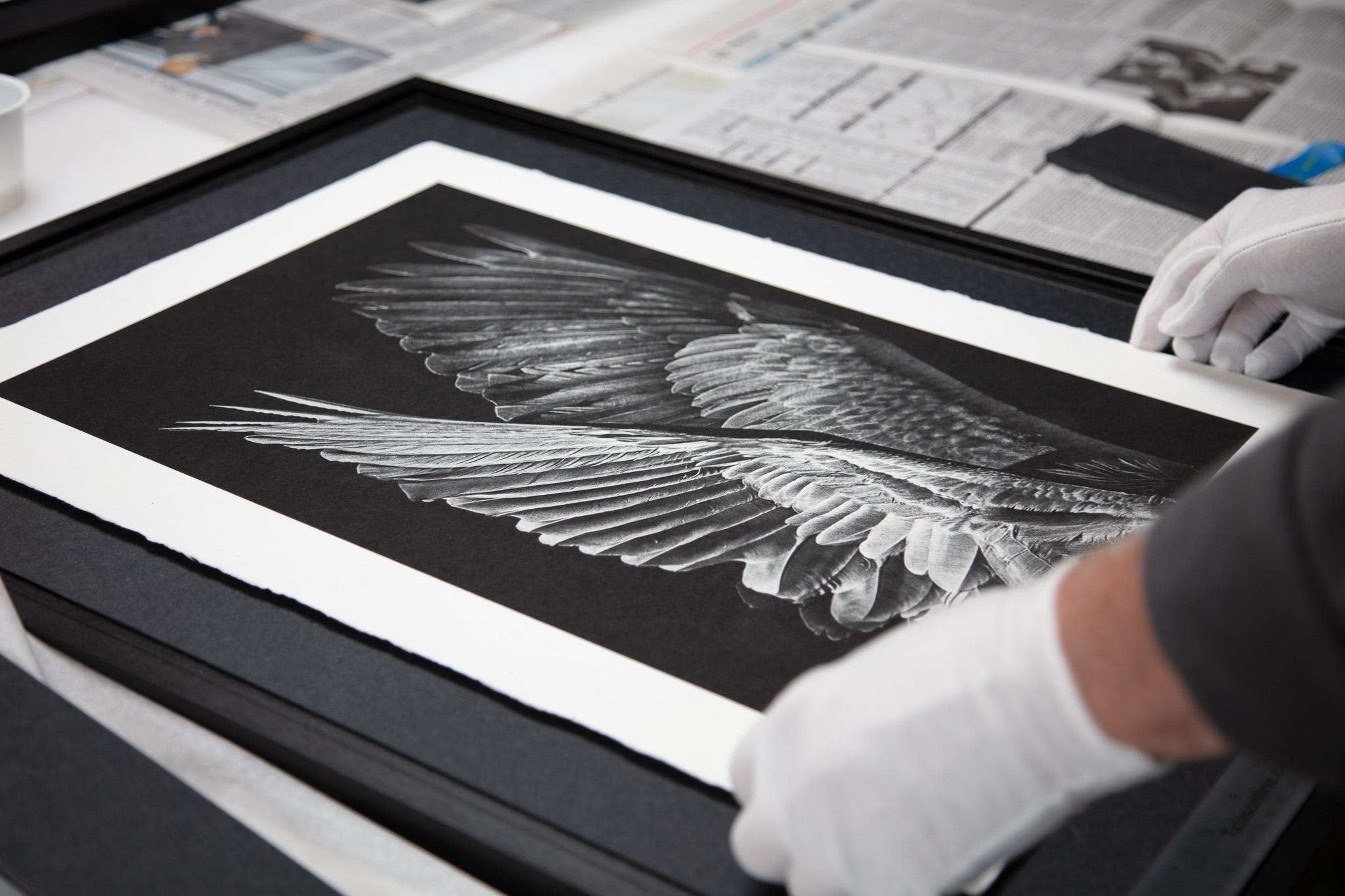
In my studio, Bob and I are careful to distinguish between fine art Limited Edition prints, proofs and workshop prints. We are careful to include new cotton gloves for every participant in our workshops and emphasize their use. But when we print proofs we typically do not use gloves but are careful to handle them only by the borders.
That brings up the issue of human hygiene. We are careful to hand wash prior to handling any prints, especially after eating. After using cotton gloves we’re careful to take them off after handling prints so that we don’t have gloves on while doing other work around the studio. That’s a recipe for disaster.
When people suggest that I make too much fuss about the print handling issue, I try to help them understand what it means to me, anyway, and should mean to them. I may travel 10,000 miles and create a huge dent in my wallet to capture an image that I think will be a great print. Then I massage it in post. Then I may do three or four proofs. Then I print it on gorgeous (and pricey) fine art paper, maybe Moab Entrada Natural or Entrada Rag Natural Coldpress 300. Why on Earth would I want to do anything that would damage the print after all the time, work, and money I’ve put into it?
Another point that I’ll add to the Breathing Color article is that once you lay a print down on a table to assess, do not ever talk about it while bent over it. That’s true in spades if you do that before the print has fully dried (think 24 hours) and has been fixative protected. All humans release some form of spittle when we talk and that can actually damage a print. Stand back when discussing print fine points with others.
And that brings up a final point about handling prints, the issue of spraying with a protective agent. I discuss this is another post and I have a video that shows the proper way to handle the spraying process. But spittle is pertinent here, too. Not the human kind but the kind that may come out of the spray can. The moral here is to buy only top notch fixative sprays like Moab Desert Spray, Hahnemuhle spray, and Printshield, which have a very fine spray. Knockoffs can sometimes shoot little globules of fixative and that will immediately ruin a print. Any print spray fixative runs the risk of “spitting” if you try spraying while the print is laying on a horizontal surface. Only spray while the print is hung vertically. On that note, stay tuned as we have some tangible tests of sprayed vs. unsprayed prints coming up soon that should be illuminating to many of you.