


I’m not the type of person that engages in the wide-spread tendency towards new year’s resolutions. Such discussions, reflections, and commitments tend toward the first week of a new year. We all know the clichés, the almost instantaneous dropping of those resolutions within days or weeks. I fully support the ongoing discipline of reflection, setting goals, and in a gentle way holding oneself to them, especially when those goals are of a personal and general nature.
That being said, culturally even those of us that have literally never uttered such a thing as a declarative new year’s resolution all of us tend towards those kinds of thoughts, if only passing, during this time of year. Here are a few things that have been on my mind all of you might find interesting in various ways related to your photography and artistic endeavors.
To AI or not to AI…
For conversation’s sake this isn’t a question posed as a hard-line embracing or eliminating all things AI in one’s photographic process. I am not suggesting the moment any AI related feature such as those we’ve seen in Lightroom, pops up in your digital processing tool of choice that it must be condemned and rejected. It’s more a question of AI generated images such as can be summoned up via various model’s prompts.
I ran across Tomaz’s (the founder and editor-in-chief of Frames magazine amongst other publications) take on AI generated images and their relationship to the practice of photography. I have similar conclusions, thoughts, and view of AI generated images overall that come from my general viewpoint of various mediums and the limitations inherent in them. I view those limitations as features rather than failings to ultimately be overcome. Beyond his views that are similar to my own, Tomaz has an interesting take I’ve not heard articulated before regarding artistic style. No matter what your view on AI generated photographic images are I encourage you to hear him out. Where do you fall?
Yes, more on still-life photography
In the latest newsletters I’ve brought up still-life a lot, even exclusively. This is more than a suggestion. I realized that many of my own photographic goals in the near future are still-life related. Many of the things on my agenda in terms of projects I will pursue happen to be still-life. To some degree I myself have been reflecting on my own failures and resolutions related to my photographic projects. There is a common factor in those failures. I put too many complicated requirements in the way that turn into perfectly valid excuses for not doing the work. This is easy to do, most of us do it without even realizing it.
For the most part still-life photography removes almost all of those built-in excuses like weather, location, subject availability, or other people. So you want to make pictures in the rain inspired by another photographer that has an amazing portfolio of pictures in the rain. It doesn’t rain every day where I live, it doesn’t even rain every week. When it does rain I am not at liberty to drop everything and go make pictures. I don’t even live anywhere near those pictures in the rain fit my vision. Sound familiar? Whatever obstacles and conditions and locations and subjects you have dreamt up, those don’t exist in virtually any still-life project.
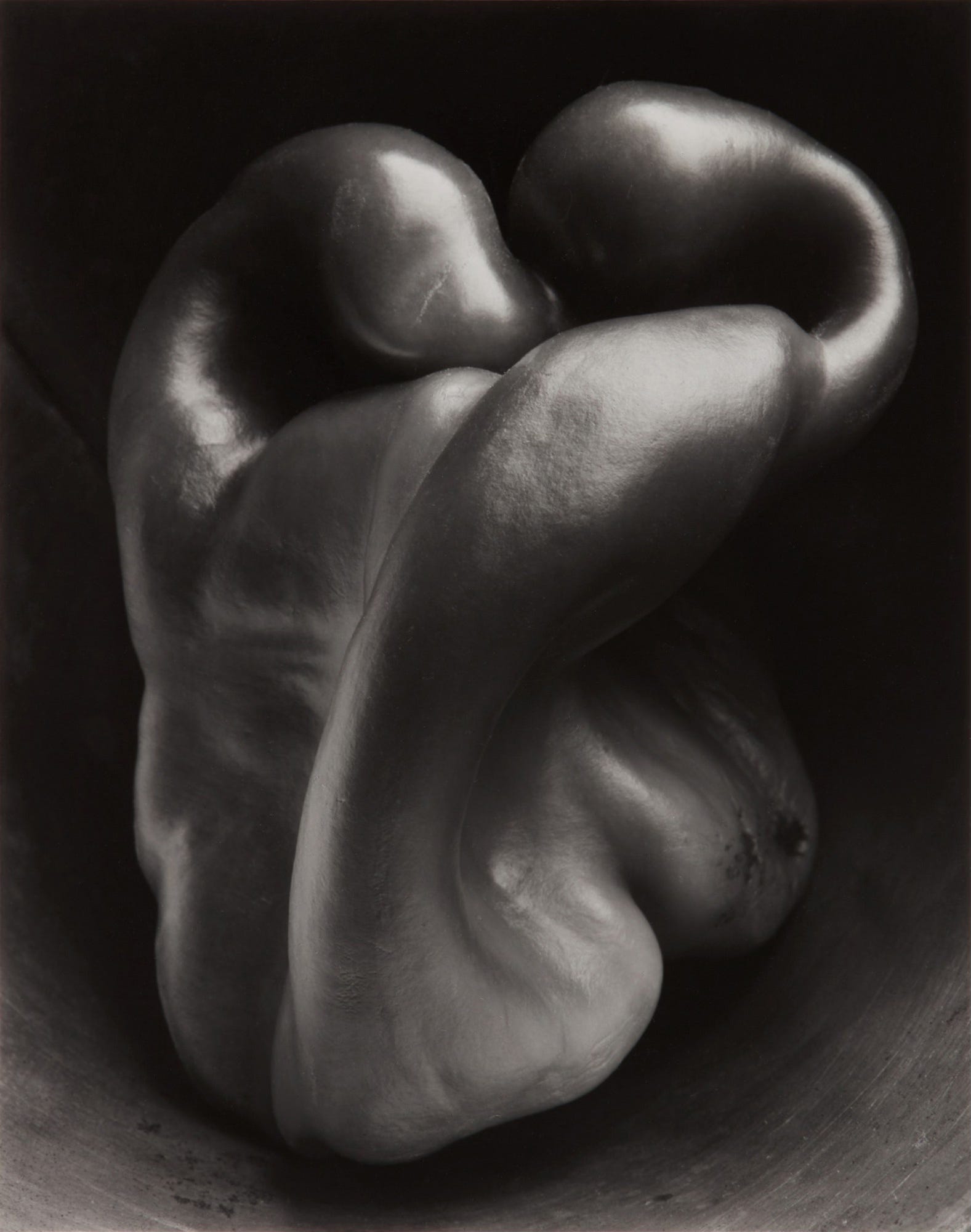
I spoke about gear-related excuses and advised avoiding those but there are all kinds things we build in that almost assures failure or at least vast swaths of unproductive time. Want some inspiration? How about Edward Weston and his peppers or for that matter all of his vegetables, and shells, and…
My 2026 project goals
Yes, quite a few of my photographic project goals are still-life oriented. I think that they evolved from a couple of years making a ton of pictures but making no progress on my personal projects. Some of that might be due to my own emotional state but I also built in some of those obstacles that turned into excuses. Here’s what simple things I have in mind for the rest of the year.
Minimalistic high-key botanical still-life. I have a general style in mind but lots to experiment with. I am also going to eliminate a built-in obstacle that those botanicals must come from my own yard or even my own harvesting in the forest I drive though almost every day. I will buy them if I must, that’s fine.
Fleshing out of that mini-project I did on leaves. Great for a few hours long mini-project but there’s so much more I wanted to try. I lost track and never followed up but have always thought there’s so much more, even a life-time of exploration right in front of me. So simple.
The county where I live is ripe with interesting scenes if approached in the right way. I already started this and at the time it was meant to be an on-going work of exploring and finding a way to present where I live in a way that expresses the history, culture, what changes, and what stays the same. My excuse? I really don’t know but it might be related to the notions of “seasons” that I accidentally built into the “theme”. I subliminally built in the notion that I already covered summertime but that’s completely untrue. I’m removing that notion completely given summertime is when I like to be outside and exploring both in the morning and the evening which happens to be the best time to make pictures outside.
The every day pictures… I see things all the time that interest me and might even inspire a project. I used to make pictures of those everyday things. I used to explore techniques that made interesting interpretations of those everyday scenes big or small. Why don’t I do that anymore? I already know the answer to that question. I’ve rediscovered it a dozen times. That answer is to go camera bag free. Even small camera bags are an obstacle for me. I could easily take a camera only with me everyday, everywhere I go. I just don’t.
Different cameras, different pictures


I am not claiming that different cameras will produce completely different results nor that different cameras are incapable of producing the same pictures. That notion is ever more untrue as time and technology marches on. If one has a scene or subject already defined and uses the same approach to making a picture almost any camera will be perfectly fine and produce very similar results. It’s more a matter of how a particular camera will influence what you actually do, what subjects you make pictures of, and how you approach them.
Look at it this way, in the past you could use very fine grain film in a Leica and a tripod, and small apertures to make fine quality landscape photographs. Some people did exactly that. If you’re going to carry a tripod and take the time to hike to a particular location, and wait for the right light, and do all the things you need to do to make a sharp, perfectly rendered landscape why would you use a Leica? Why not just use a camera more suited to that style of working? Maybe that’s the only camera you have? Great, use the Leica but if tripod mounted landscapes are everything you do, maybe you should consider a different camera?
Fast forward to the digital age where the image quality factor is less and less related to the size of the camera. If I were in a workshop teaching people various techniques such as hand-held intentional camera motion as a creative option, spontaneous framing, blind shooting at unconventional viewpoints, and things like that I could use any digital camera I own. They are all capable of the same things, technically… The real question is will I actually do those things in my every day photography. For myself the answer is no because those things usually come about as a reaction to scenes and subjects I come across rather than set out to do. The problem is I don’t have a camera with me because I don’t want it banging around and I especially don’t want a camera bag.
I need a new camera, a bag-free camera. This sounds like G.A.S. as I have plenty of cameras that are all capable of making any picture I want to make, however I want to make it. It’s not G.A.S. I just am not willing to have a camera on a strap banging around all the time, they’re also too expensive, I have to pay attention to them everywhere I am, I can’t just lay them down somewhere without continuously keeping an eye on them. That’s fine for when I have intent to go make pictures. It’s not fine when I’m not.
I used to carry my Leica around all the time, that was a different age, I was a lot younger and that was the best option I had. I tried loving and treating an X100 the same way, never really gelled, I tried the same thing with an X-Pro, same result. I have film and digital Leicas but still the reality is I don’t want a camera banging around if I am not intentionally going to make pictures. I had the answer but sold it, probably because I bought it during a time when I was making pictures almost every day with my other gear so it seemed superfluous. It was superfluous. Today is a different day, a different year, I make a lot of pictures but I don’t have that intent every day, therefore I don’t have a camera everyday but I miss having one.
For some the iPhone fills that role. Nope, just doesn’t work for me. No matter how good they are, controlling them is too fiddly, holding them is awkward, the results in terms of “good” are evermore in only one dimension aesthetically. What I really want is exactly what the Ricoh GR, the first and ongoing APS-C versions offer. I had the first version with the 28mm, they’re offered in both 28mm and 40mm versions now, either would do for me but this is exactly what I need. In fact I am fine with the first version. I just might grab one of any varieties to forward my everyday picture goals. I might even make a resolution to actually make a picture with it everyday should I decide to pull that trigger…
Key Aligning Trends and Floral Fit
Biophilic/Nature-Inspired Design and Bringing the Outdoors In: 2026 prioritizes wellness through natural materials (wood, stone, plaster, grasscloth), earthy tones (moss green, olive, terracotta, artichoke green, deep blues/browns), and elements that evoke nature. Foliage patterns, botanical tapestries, and murals are explicitly noted. Floral artworks extend this by introducing botanical illustrations, nature prints, or floral murals that mimic greenery without maintenance, enhancing calm, restorative spaces.
What about the FujiFilm X100VI or the XE-5 with a changeable lens? Or is the Ricoh that much smaller to be pocketable?