

Why do we use pigment ink printers? The printers are expensive relative to dye printers. The ink is expensive compared to dye-based ink. Lastly, it might be a surprise to those not steeped in photographic printmaking, but pigment ink has a smaller color gamut for those looking for the maximum amount and range of ”colors”.
Most readers will probably answer that question with the fact that pigment printers have superior archivalproperties. That is absolutely true but is probably less so than a decade or more in the past. Some newer dye ink printers even have hybrid dye/pigment black ink now. So what else beyond archival properties? The answer is superior black density and DMAX on matte papers.
The range of surface textures, base tone, and luxury hand feel is immense when discussing fine art matte papers. IMHO the diversity of choices is far greater in matte paper than any sort of glossy photo papers. Sure, there are differences in various glossy papers, but it’s not nearly as wide.
Great, pigment printers are more archival and generally have superior rendering when using matte black pigment ink on fine art matte paper. Sounds like that’s the way to go then, right? Absolutely, but there’s a caveat that you might not be aware of. No matter what material you print on, matte black ink is less physically durable than photo black ink. The reason is that the pigment particle size is far larger than photo black ink (as far as my basic understanding).
We often have need to print on materials that are not specifically for photo-accurate color or maximum black density. One example is for the book-making project that Les and I talk about frequently. The book cover canvas-like material he uses is not manufactured to be printed on, but we do use our printers to render a title and some other information on it. The book is meant to be handled, so we tested matte and photo black ink and did a simple abrasion test using another scrap of paper. The cover material printed with matte black ink rubbed away far more easily than the one printed with photo black ink. This is true for other papers as well.
Don’t think that this is true only with uncoated materials. It’s true across the board. Materials like the canvas or the vellum overlays we frequently use in portfolios immediately register as “matte.” For non-photographic work on those materials, we use photo black for enhanced physical durability and less propensity to transfer onto other papers in the case of the vellum overlays.
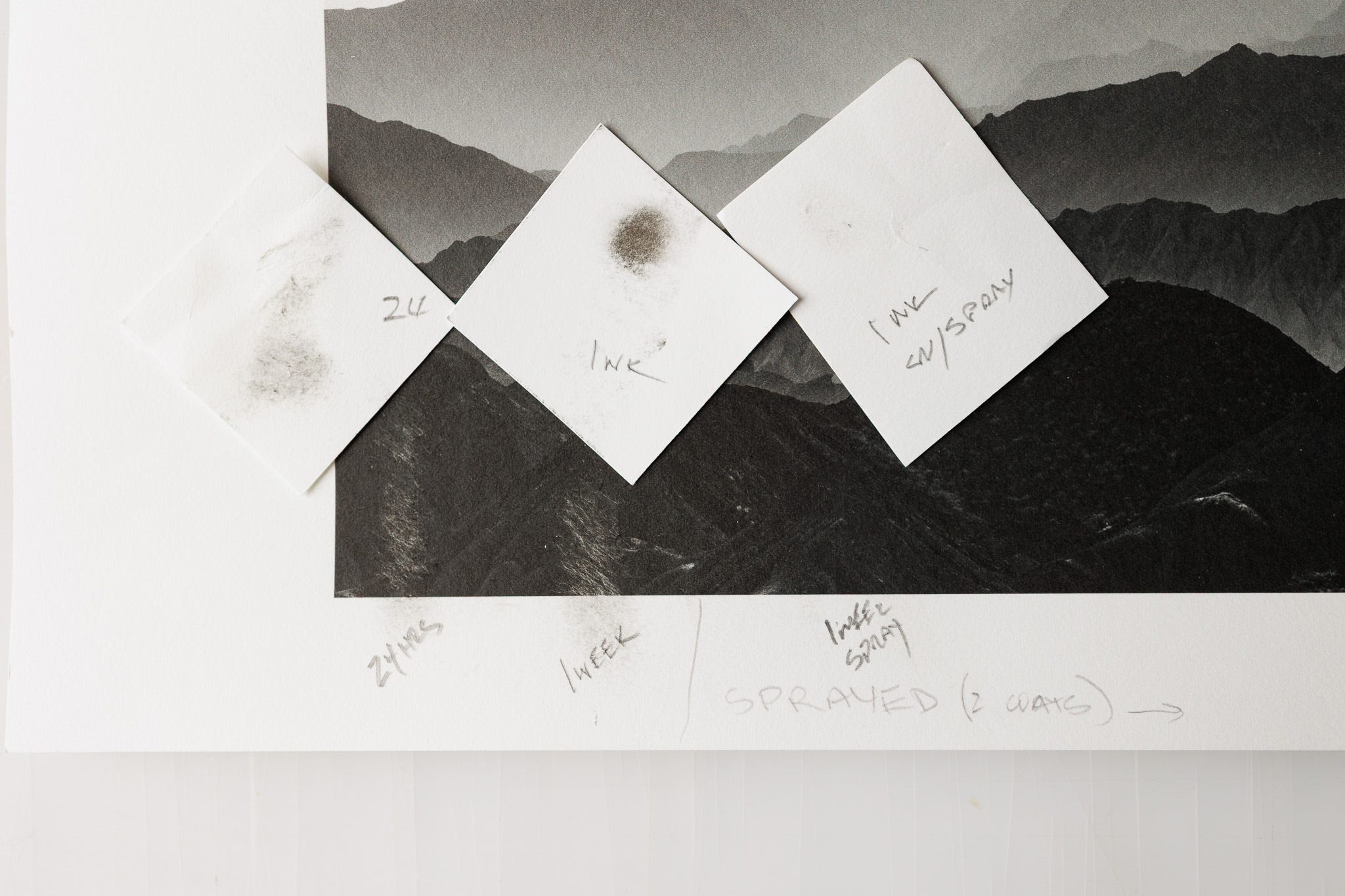
Of course, we use matte black ink to print photos on matte fine art papers. Take a look at the illustration at the top. A print made with matte black ink. Note the amount of destruction caused by rubbing a piece of paper on the print one hour after it was printed. The same thing happens after a week. No amount of dry time improves the durability. We then used Moab Desert Spray on the print and performed the same test; I used a piece of paper to rub the print even harder.
While I cannot produce a scientific set of numbers in terms of force, the qualitative results are 1000% better in terms of protecting the print against abrasion and ink transfer. This is the biggest reason I could possibly endorse using these print fixatives. Before you go out and buy any old spray fixative, realize they are not all the same. There are only three brands we can attest to in terms of not changing the appearance of the original print. The first is the Moab that I referred to above. Feel free to ask about the other two if you’re interested.
Yes, please. What are the other two fixatives? Do you think they all perform equally well on a matte paper print that’s been embellished with materials such as ink, pastel, charcoal, etc?
For a high quality print hanging on the wall, maybe behind glass. For a book, Protective coating or the protective sheets used between prints. & maybe gloves. Premier distributed by Red River, Hahnemuhle , Krylon are possibilities. I have never used one as of yet. Great read!