

No matter if you’re just starting out or you’ve been making prints since the dark ages of the darkroom making proofs is an essential part of making prints. The medium of print is different than on-screen viewing. Yes, getting a decent print is far easier and quicker than it was in the darkroom days but it’s not as different as one would imagine.
Consider this; If one had a calibrated process way back in the film days there were not many crazy surprises or variations when you made your first contact sheet. Sure there may have been a few frames here and there that needed “special treatment” or a different contrast paper than the rest of them but for the most part there weren’t a ton of variations in terms of the print output that you didn’t expect. Of course seeing that and making those corrections happens before the first print now. Now, just like the old days that was the beginning, next came one or more proof prints, especially before printing large.
Want to cut your cost for making proofs in half? Consider using double sided paper. I briefly mentioned this a few weeks ago in the “Piles of Proofs” newsletter. If you use Moab Entrada Rag all of those papers are double sided. Of course if you want to side-by-side the proofs you’ll need multiple sheets. Save them and use them again. Other papers have double sided versions as well, such as Canson Photographique II. This paper comes either single or double sided. The single-sided version costs around $37 for 25 sheets of letter sized and around $34 for the duo. That’s more than half. Maybe a retailer pricing anomaly but you get the idea. Even if the double sided paper is a few dollars more that would be a substantial savings for proofs.
Another tip to save a little money; If given a choice for your go-to paper, buy the lighter weight paper. For instance, Moab Entrada Rag comes in 190 gsm and 300 gsm, typical of fine art mat papers. We use far, far more of the 190, this is especially true in larger print sizes. In general the lighter weight paper costs a little less but is easier to handle when mounting large prints and you cannot tell the difference. We tend to use the heavier weight versions when the prints are meant to be handled as in a portfolio.
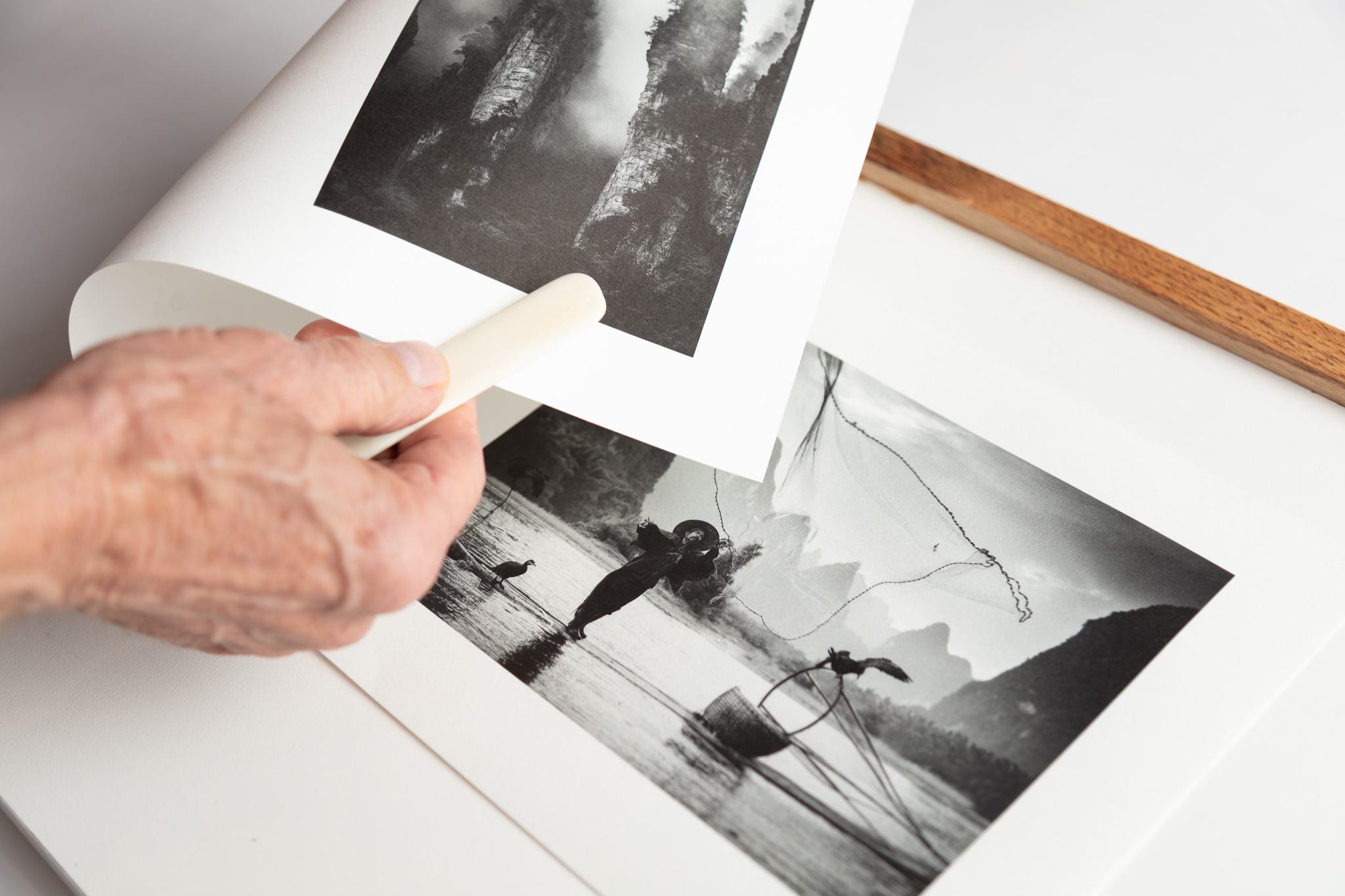
Here’s another thing to consider regarding double sided paper; you’ll need when making a book when using a traditional method of stitching signatures together. A signature is made up of multiple folios. A folio is a single sheet folded in half. Take a look at the photo above. Note that both sides of the paper need to be printable even if you plan on only one photo per side, both sides of the paper are used when folded in half. More on books coming soon in our DIY series. In fact the homemade folding jig is discussed in that series already… We use double-sided paper all the time for small runs of gallery catalogs, invitations, holiday cards, and brochures all the time when we want a high-end feel for an exhibition etc.
A use I've found for double sided prints is pinning them to the ceiling In transparent album envelopes so you can see both side, two different images, as you walk through the room. Eccentric maybe, but I like to play with print placement in a room to tease the eye.
You wrote: "The single-sided version costs around $37 for 25 sheets of letter sized and around $34 for the duo. That’s more than half." Maybe your writings could use a little proof reading?!